Transvolt
I was the only designer on a cleaning module for one bus depot in north Mumbai. The people in the room were depot managers, cleaning supervisors, and crew leads.
Context and people
One depot in north Mumbai. The users are depot managers, cleaning supervisors, and crew leads. I went through four or five rounds of discussion with stakeholders, then one site visit, to gauge the scale of what we were proposing.
Framing question
Design moves
Manager, supervisor, crew supervisor, depot, and fines are five views of the same module. That structure is the frame the moves sit inside. It is not a move on its own.
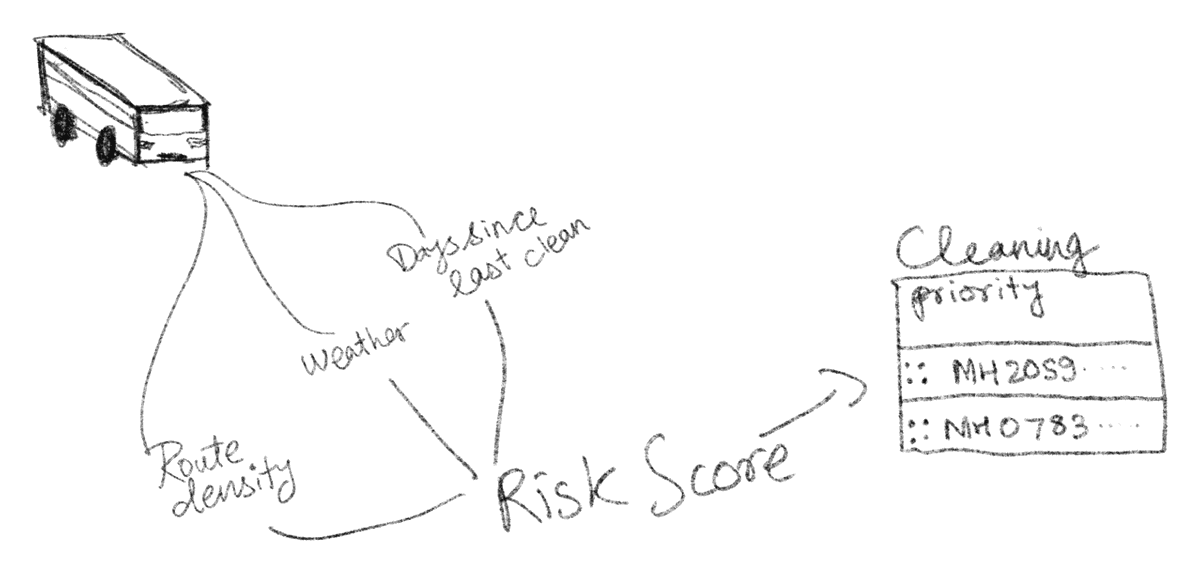
A risk score
It ranks buses so the dirtiest get cleaned first. I picked the signals.
Route density: more riders getting on means more dirt coming in. That is first-principles reasoning from how a bus actually fills up.
Rain: it was monsoon, and I had seen how muddy Mumbai's local trains got on wet days. That observation came from other public transport, then I brought it into the depot.
Days since the last deep clean: dirt builds over time, and the depot already required a deep clean every six months.
The output is an approve-or-audit decision. A flagged bus surfaces as one score, and someone either approves the clean or audits it.
A fines flow I slowed on purpose
This one was my idea. In class we had learned that most design takes friction away, and that sometimes the friction is the point, a necessary evil.
Fines land on the supervisor. Handling one is slower and more tedious on purpose, so a supervisor would rather avoid the error than go through the flow. It shapes behaviour without anyone having to say so. It is the same bet as the line on the homepage: design for how something feels before picking a method.
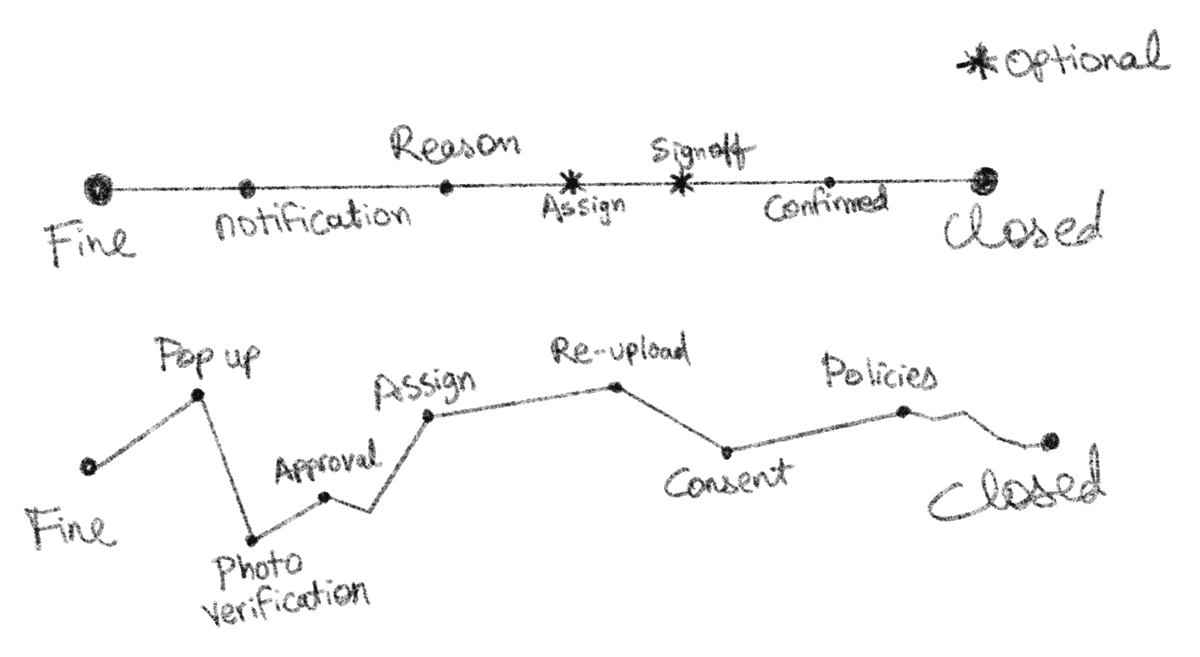
Open risk, still to test: it could feel punitive, or supervisors could start hiding errors.
What testing changed
Before, the depot used random spot-checks. Seeing the depot, and going through the numbers with the cleaning team, showed that random checks could not cover that many buses. After that, the risk score.
Role
I was the only designer. I worked with developers, a PM, and executives.
Learning
Also at Transvolt
Ultratech fleet-ops dashboard
The developers worked on laptops and had built a kanban-style interface that scrolled sideways. I questioned whether depot managers actually use a laptop, or a fixed PC with a mouse. I assumed a fixed PC, then confirmed it on a video call with one manager, and suggested tabs with larger hit areas. I left before it reached production. The next step is to watch a manager use it mid-shift.
Also redesigned transvolt.in to give it a more coherent, modern look.